


DAQ
data acquisition, measurement data acquisition, ADC, digitizer, TDC, time tagger, data acquisition system
DAQ is the abbreviation for data acquisition. It describes the acquisition, digitization, transfer, and delivery of measurement data for storage, analysis, or control. Sensors and detectors convert physical quantities such as light, pressure, temperature, or the arrival of a particle into electrical signals. A DAQ system conditions these signals and transfers the resulting measurement data to a computer or another processing system.
Different digitization methods are used depending on the measurement task. An analog-to-digital converter (ADC) samples the instantaneous amplitude of an analog signal at defined time intervals and quantizes each sample. High-speed ADCs, also known as digitizers, can operate at several gigasamples per second and capture short pulses and fast waveforms. In addition to an event’s arrival time, they preserve information about its amplitude, pulse shape, and pulse area.
A time-to-digital converter (TDC) primarily records the time of a signal edge or the time interval between events. Its output consists of timestamps or time intervals rather than a complete analog waveform. TDCs are therefore particularly suitable when very high timing resolution is required but the full pulse shape is not needed. Depending on the instrument, both rising and falling edges can also be recorded to determine pulse width.
In addition to the ADC or TDC, a high-speed DAQ system may include an analog front end, discriminators, trigger and synchronization functions, a precision time base, FPGA-based processing, data buffers, and a high-bandwidth host interface. At high sample or event rates, data is commonly transferred directly into the host computer’s memory using PCIe and direct memory access (DMA).
The performance of a DAQ system cannot be described by a single specification. Important ADC parameters include sampling rate, analog bandwidth, resolution, effective number of bits, and sustained data throughput. For TDCs, relevant parameters include bin size, timing uncertainty, double-pulse resolution, dead time, and sustained event rate. Hardware-based triggering, buffering, and data reduction—for example, transferring only relevant pulse regions—can significantly reduce the amount of data that must be transferred and processed.
High-speed DAQ systems are used in applications such as time-of-flight mass spectrometry, LIDAR, time-domain reflectometry, time-correlated single-photon counting, and the acquisition of fast photon and particle detector signals.
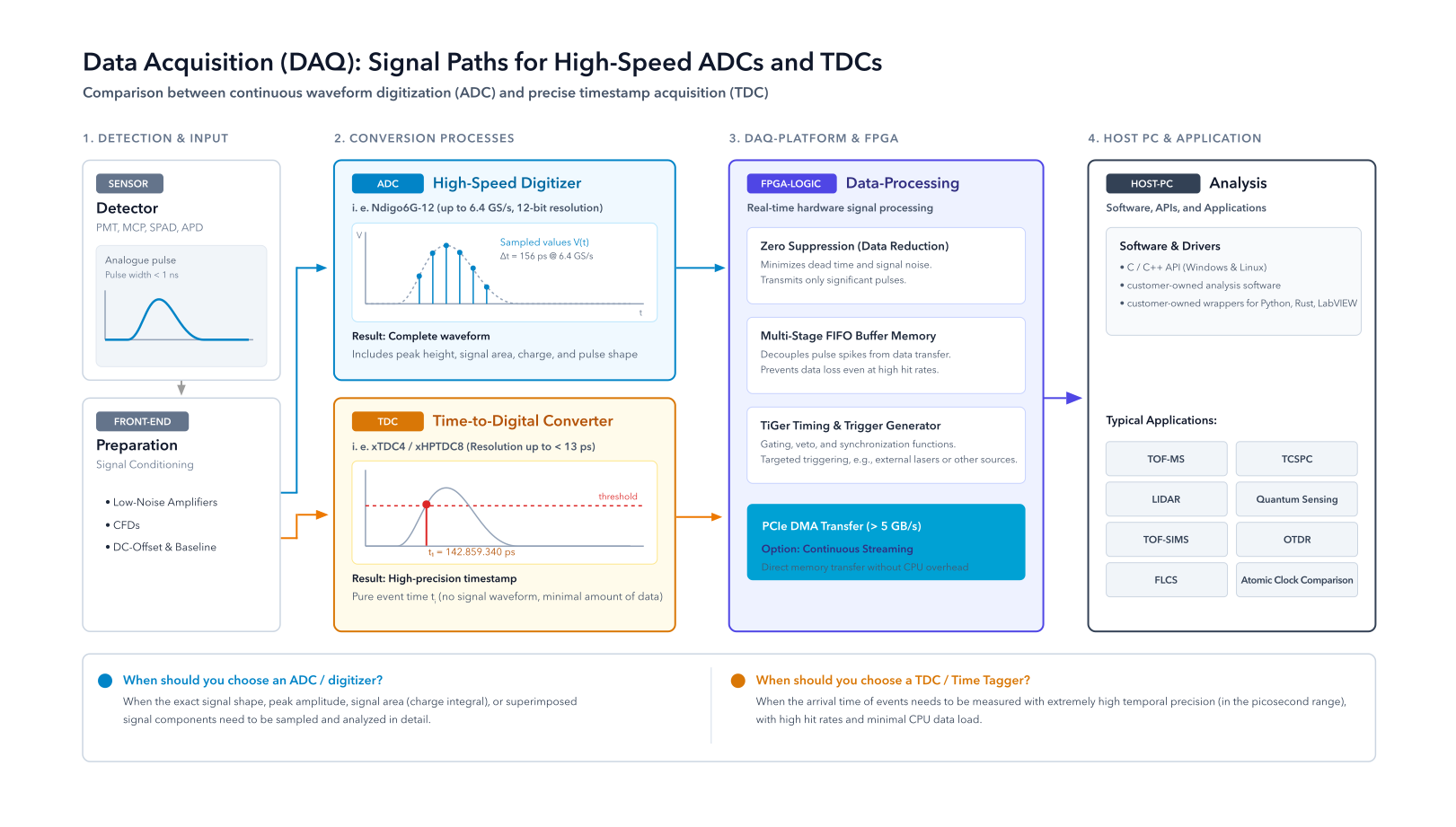
A DAQ system converts detector signals into digital measurement data. A high-speed ADC captures the waveform as a sequence of amplitude samples, while a TDC provides precise timestamps for detected events. Triggering, FPGA processing, buffering, and a high-speed host interface support continuous acquisition at high data rates.