


ADC
digitizer, amplitude converter, data analyzer, digitizer, transient recorder, analog-to-digital converter
Analog-to-digital converters (ADCs) are electronic circuits that convert an analog input signal into a sequence of digital values. To achieve this, the instantaneous signal amplitude is sampled at regular time intervals and quantized with a defined resolution. High-speed ADCs with sampling rates of several gigasamples per second (GS/s) are often referred to as “digitizers” or "transient recorders". They enable very short electrical pulses and fast signal waveforms to be captured in their entirety and subsequently analyzed digitally.
Two key characteristics are the sampling rate and the vertical resolution. The sampling rate determines the time interval between individual samples. At a sampling rate of 6 GS/s, for example, the input signal is sampled approximately every 167 ps. The resolution in bits, on the other hand, describes how finely the input voltage range can be divided into discrete amplitude levels. A 12-bit ADC can theoretically distinguish between 4096 different values.
Unlike a Time-to-Digital Converter (TDC), which primarily records the time of an event, an ADC digitizes the waveform of the analog input signal over time. This preserves information not only about the event timing but also about the amplitude, pulse shape, and pulse area. High-speed ADCs are therefore particularly suitable for applications where the complete waveform of fast detector signals is relevant for further analysis.
Sampling rates of several GS/s generate very large amounts of data. cronologic high-speed digitizers are therefore optimized to detect pulses during continuous data acquisition and stream the relevant samples directly into the computer’s main memory. This eliminates the need to continuously store the entire ADC data stream, reducing the amount of data transferred as well as latency and CPU load.
A specially developed PCIe DMA controller provides data transfer rates of up to 6 GByte/s and manages the required buffer data structures largely without software intervention. This enables efficient processing even at high event rates.
High-speed ADCs and digitizers are used in applications including time-of-flight mass spectrometry (TOF-MS), LIDAR, spectroscopy, and the acquisition of fast photon and particle detector signals.
You also might like to have a look at the cronologic ADCs Ndigo5G-10 and Ndigo6G-12.
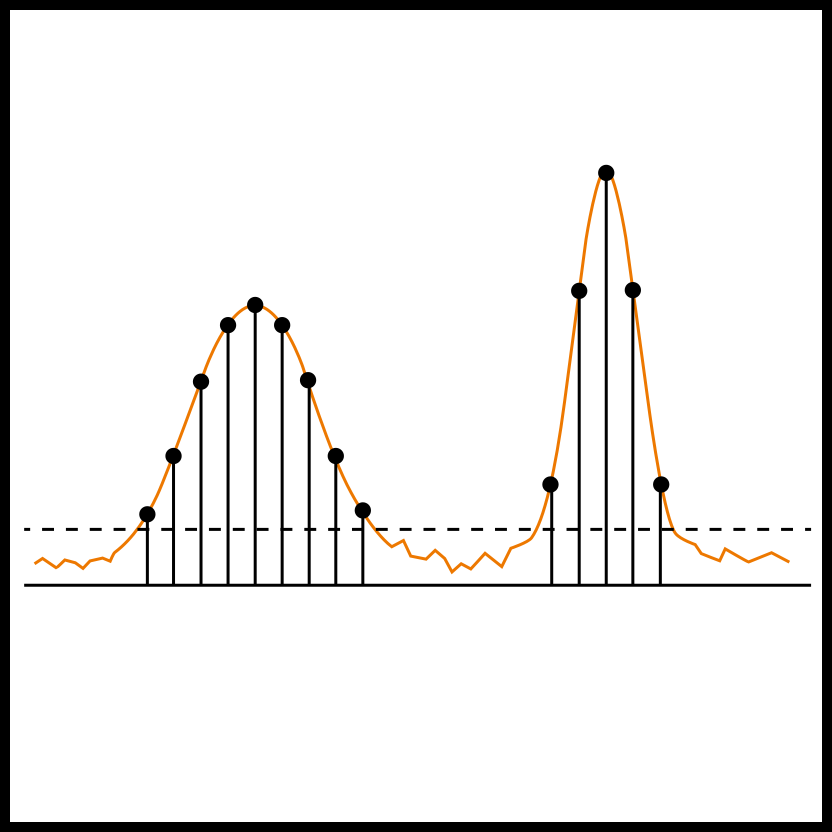
cronologic ADCs capture analog signals through high-precision sampling and quantization, converting them into digital values. These form the basis for real-time signal analysis and further digital signal processing. The dashed line indicates a configurable threshold that can be used to identify relevant pulses. Combined with the integrated zero suppression, only the signal regions of interest are transferred, significantly reducing the amount of data that needs to be transmitted.