


double-pulse resolution
DPR, pulse-pair resolution, two-pulse resolution, multiple-hit dead time, dead time, Time-to-Digital Converter, Time Tagger, Digitizer, ADC, Discriminator, ToF-MS
Double-pulse resolution (also referred to as pulse-pair resolution or two-pulse resolution) is the minimum time interval required between two consecutive pulses on the same input channel for both events to be detected, separated, and measured reliably.
It is a key figure of merit in time-resolved data acquisition systems, defining the single-channel minimum dead time for closely spaced multihit events.
Double-Pulse Resolution in Time-to-Digital Converters (TDCs)
A Time-to-Digital Converter (TDC) or Time Tagger records discrete edge timestamps (threshold crossings). If two pulses arrive at the same channel within a time interval shorter than the instrument's double-pulse resolution, the second pulse is swallowed and lost due to channel dead time.
The double-pulse resolution of a TDC is determined by two main factors:
- Analog Front-End and Comparator Recovery:
Following the first leading edge, the analog pulse must fall back below the discriminator threshold (including comparator hysteresis) before a second edge can trigger. Furthermore, analog discriminators and input stages require a finite recovery time (overdrive recovery) before returning to their baseline state. - Digital Core & Latching Dead Time:
The TDC conversion core, encoding pipeline, and multihit register stages require a minimum number of clock cycles to latch the timestamp into internal FIFO buffers and re-arm the channel for subsequent events.
Burst Rate vs. Continuous Data Rate:
The inverse of the double-pulse resolution (f_max = 1 / DPR) represents the maximum instantaneous burst event rate for consecutive pulses. For example, a double-pulse resolution of 2.5 ns allows an instantaneous peak rate of 400 MHz on a single channel. The continuous, sustainable event rate, on the other hand, is governed by the interface bandwidth (such as PCIe DMA) and internal FIFO memory depth.
High-performance TDCs from cronologic (such as the xHPTDC8 or xTDC4) utilize custom ASICs designed for ultra-low dead time and nanosecond to sub-nanosecond double-pulse resolutions.
Overcoming the Double-Pulse Limit by Using High-Speed ADCs
While TDCs are inherently bound to threshold levels and dead times by design, high-speed ADCs and digitizers (such as the Ndigo series) have no threshold dead time:
- Full waveform sampling: An ADC continuously digitizes the entire analog voltage waveform.
- Resolving overlapping pulses (pile-up): If two pulses arrive so closely spaced that the signal does not drop below the trigger threshold, a TDC loses the second event. A fast digitizer, on the other hand, captures the complete composite waveform.
- Digital pulse separation: Using mathematical algorithms (deconvolution, peak fitting, or digital CFD) in the FPGA or in post-processing software, overlapping signal peaks can be separated and their exact arrival times, amplitudes, and charge quantities can be reconstructed.
For certain applications with extremely dense pulse sequences or overlapping detector pulses (e.g., in time-of-flight mass spectrometry or LIDAR measurements), high-speed ADC digitizers can therefore represent a powerful alternative to TDCs. However, trade-offs must be evaluated regarding the higher data volume, increased computational effort, signal-to-noise ratio requirements, power consumption, and cost per channel associated with ADCs.
Practical Applications
Minimizing double-pulse resolution is essential across a wide range of demanding applications:
- Time-of-Flight Mass Spectrometry (TOF-MS / ToF-SIMS): Essential for resolving closely spaced ion peaks arriving at the detector within nanoseconds of each other.
- LIDAR and Bathymetry: Resolving adjacent reflections, such as distinguishing the water surface return from a shallow seabed or separating canopy layers from ground returns.
- Time-Correlated Single Photon Counting (TCSPC) & FLIM: Recording multiple photon events within a single excitation cycle without loss.
- Nuclear and Particle Physics: Detecting rapid decay chains and multi-particle burst events.
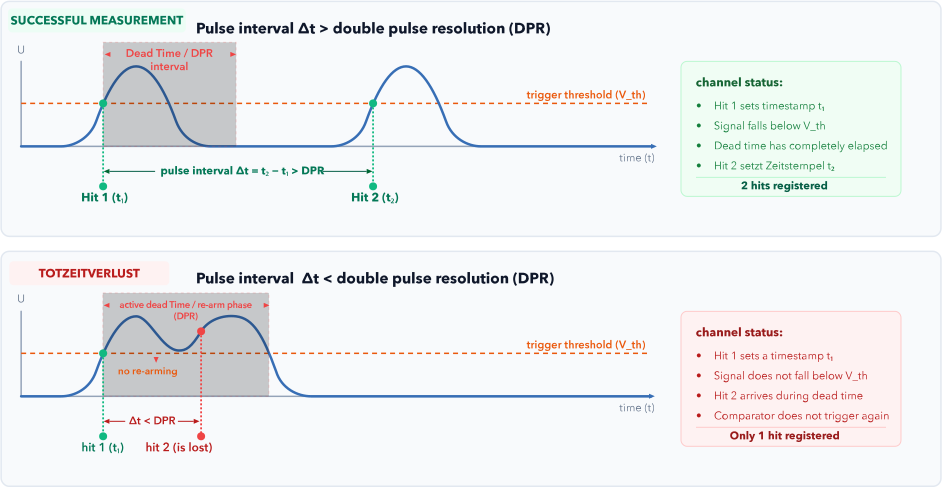
Relationship between double-pulse resolution and dead time in a TDC: If the time interval between two pulses is larger than the double-pulse resolution (Δt > DPR, top), both edges are successfully registered. If the interval is shorter than the double-pulse resolution (Δt < DPR, bottom), the second event falls into the channel dead time and is lost.