


averager
signal averager, averaging digitizer, averaging ADC, waveform averager, co-adder, co-adding digitizer, hardware averager, boxcar averager, boxcar integrator
An averager is a type of ADC digitizer that acquires multiple repetitions of a triggered waveform and calculates their average before the data is transferred to the host computer. Averaging reduces random noise and can significantly improve the signal-to-noise ratio for repetitive signals. At the same time, the required data bandwidth can be greatly reduced because not every individual acquisition needs to be transferred.
The disadvantage of hardware averaging is that the individual acquisitions are no longer separately available for subsequent analysis. This limits the ability to perform pulse-by-pulse processing, reject individual events, classify pulses, or apply other analysis methods based on the individual acquisitions.
The cronologic Ndigo6G-12 supports hardware averaging as an optional part of its acquisition process. In normal operation, recorded trigger events are transferred to the host as individual data packets. In Averaging Mode, a configurable number of trigger events is accumulated and averaged before an output packet is generated and transferred to the host. This can significantly reduce the amount of data that needs to be transferred when only the averaged signal is required for the application.
Zero suppression can be used independently of averaging. It reduces the amount of acquired and transferred waveform data to the relevant signal regions and is available both during individual trigger-event acquisition and in Averaging Mode. Zero suppression and hardware averaging can therefore be combined to further reduce the amount of data that needs to be transferred.
The appropriate acquisition strategy depends on the application: transferring individual trigger events preserves the information from each acquisition for flexible post-acquisition analysis, while hardware averaging reduces data volume by combining multiple trigger events before transfer.
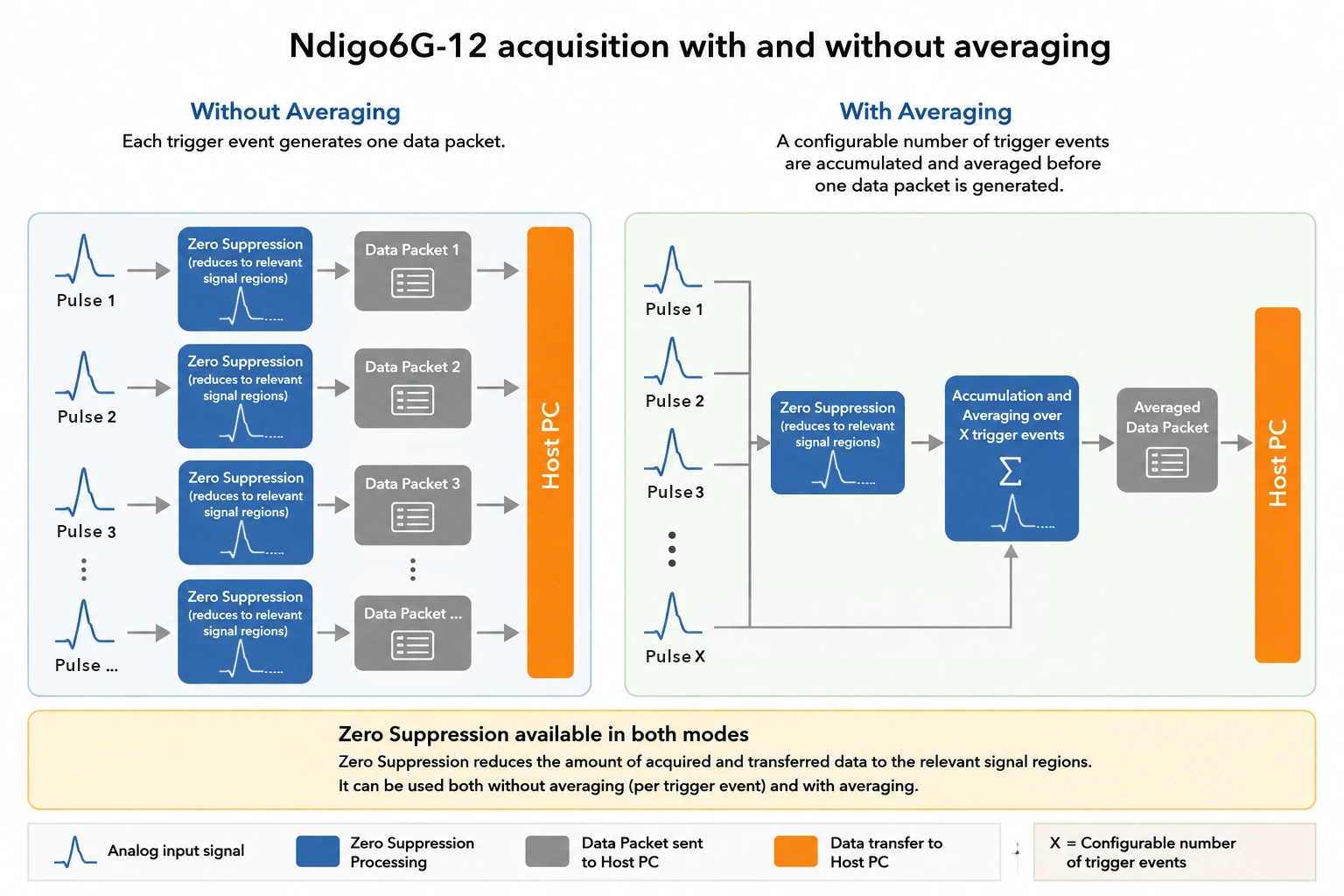
Comparison of data acquisition with the cronologic Ndigo6G-12 with and without hardware averaging. Without averaging, recorded pulses are transmitted as individual data packets. In averaging mode, a configurable number of trigger events are first accumulated and averaged before a data packet is generated. Zero suppression can be used in both operating modes.