


coincidence measurement
coincidence counting, coincidence method, quantum communication, multiple detector systems
A coincidence measurement is a measurement technique used to identify temporally correlated events. A coincidence occurs when two or more detection events are registered within a predefined time interval, known as the coincidence window. In this way, signals originating from the same physical process can be reliably distinguished from background events that occur simultaneously by statistical chance. The width of the coincidence window affects both the probability of detecting true coincidences and the number of random coincidence events.
Coincidence measurements can be performed using multiple synchronized detectors or multi-hit capable detectors that can record several nearly simultaneous events with short dead times. Today, the timing of these signals is typically determined using high-resolution Time-to-Digital Converters (TDCs), which measure the arrival times of individual events with resolutions down to the picosecond range and allow them to be correlated with one another. This enables even complex multi-channel experiments to be analyzed with high precision.
Coincidence measurements play a central role in numerous scientific and industrial applications. Typical fields of application include the detection of entangled photons in quantum optics and quantum communication, Time-Correlated Single Photon Counting (TCSPC), Positron Emission Tomography (PET), experiments in nuclear and particle physics, as well as COLTRIMS and reaction microscopy. In all of these fields, the temporal correlation of measurement events provides valuable information about the underlying physical process while simultaneously improving the signal-to-noise ratio by suppressing uncorrelated background events.
cronologic Time-to-Digital Converters continuously record the timestamps of all input signals with high precision. Rather than evaluating coincidences during data acquisition using fixed hardware logic, the timestamps can be processed flexibly in the user's own software. This allows coincidence windows, analysis algorithms, and selection criteria to be adjusted even after a measurement has been completed, without having to repeat the experiment. This software-based approach provides a high degree of flexibility, particularly for complex or changing measurement tasks.
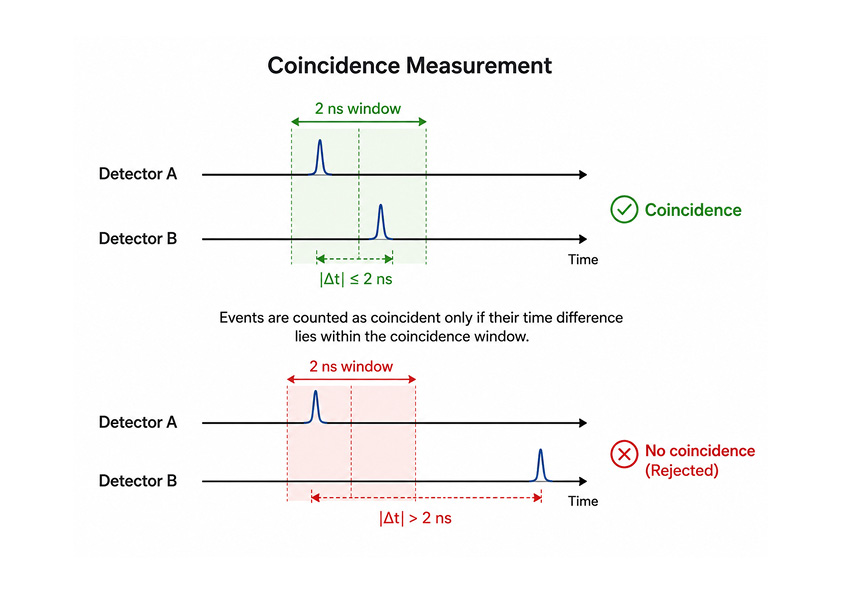
Schematic illustration of a coincidence measurement: events from two detectors are counted as coincident when their time difference lies within the defined coincidence window.