


Discriminator
CFD, Constant Fraction Discriminator (CFD), Time-to-Digital Converter (TDC, time tagger), Time-Walk, Time-over-Threshold (ToT), Jitter, Ndigo Digitizer, TCSPC, ToF-MS
A discriminator is an electronic circuit that converts analog detector signals (e.g., from PMTs, MCPs, SiPMs, APDs, or scintillators) into standardized digital logic pulses or precise timestamps. In time-resolved measurements, the discriminator output marks the exact arrival time of a detection event for subsequent processing by Time-to-Digital Converters (TDCs, time taggers).
Common Discriminator Types:
- Leading Edge Discriminator (LED): The simplest and fastest design. It compares the input pulse against a fixed voltage threshold (Vth) and switches when the threshold is crossed. However, varying pulse amplitudes cause an amplitude-dependent timing error known as time-walk, where higher pulses trigger earlier than smaller ones.
- Constant Fraction Discriminator (CFD): Triggers at a constant fraction of the pulse peak amplitude (typically 20–40%). This eliminates time-walk for pulses with consistent rise times. (For details, see our dedicated CFD glossary article).
- Zero-Crossing Discriminator (ZCD): Primarily used with bipolar or differentiated detector pulses to detect the zero-crossing baseline transition independent of pulse height.
Discriminator Technology in Modern High-End DAQ at cronologic:
- Integrated Per-Channel Comparators & Time-over-Threshold (ToT) in TDCs: cronologic TDCs, such as the xTDC4 or xHPTDC8, integrate software-programmable, high-speed comparators with individually configurable thresholds (positive or negative) on every channel. By measuring both rising and falling edges with picosecond precision, the pulse width (Time-over-Threshold, ToT) is captured. Time-walk can then be numerically calibrated and eliminated in software without analog CFD hardware. Detector signals can also be routed across multiple channels with staggered thresholds (multi-threshold sampling).
- Digital Discrimination with High-Speed Digitizers: With cronologic Ndigo series digitizers (5 GS/s and 6 GS/s), the entire analog waveform is digitized directly. Digital CFD (dCFD) algorithms, Gaussian peak fitting, and digital filtering run in real time on the FPGA or host system, providing maximum flexibility even in high-noise and pulse-pile-up environments.
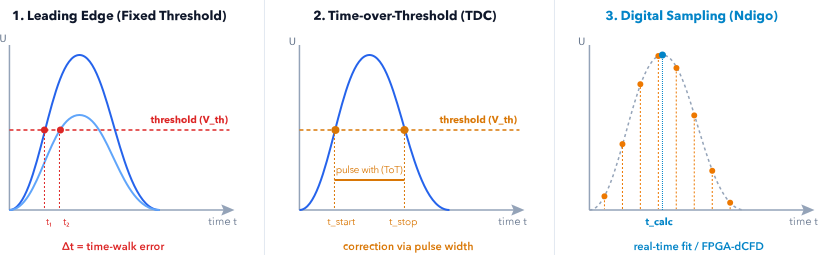
Operating principle of a discriminator: Converting analog detector pulses into digital timing data via fixed thresholds (Leading Edge), pulse-width measurement (ToT), or direct digital waveform sampling.