


digitizer
ADC, Analog-to-Digital Converter, Transient Recorder, DAQ, TDC, Time-to-Digital Converter, Time Tagger, Zero Suppression, Averager, Sampling Rate
A digitizer (also referred to as a high-speed digitizer, PC-based digitizer, or transient recorder) is a complete data acquisition instrument designed to convert continuous analog signals into digital data with high sampling rates and high vertical resolution. Unlike a standalone analog-to-digital converter (ADC) chip, a modular digitizer incorporates the entire signal chain: an analog front-end (AFE), ultra-low-jitter clocking, high-speed ADC cores, real-time FPGA processing, and high-throughput bus interfaces (such as PCIe).
In measurement technology and electronics, the term “digitizer” is practically used synonymously with a high-speed ADC-based measurement system.
Key Architecture & Core Features
- Analog Front-End (AFE): Provides signal conditioning including 50 Ω or high-impedance termination, programmable gain/attenuation, offset calibration, and anti-aliasing filters to feed clean signals to the converter.
- High Sampling Rates & Resolution: Advanced digitizers like the Ndigo6G-12 provide sampling rates up to 6.4 Gsps with 12-bit vertical resolution, allowing precise acquisition of nanosecond and picosecond pulses without distortion.
- Onboard FPGA Signal Processing: Integrated FPGAs perform real-time preprocessing before transferring data to the host. Features include zero suppression to eliminate empty baselines, digital baseline restoration, threshold triggering, and hardware averaging.
- High-Speed PCIe DMA Streaming: Modern PCIe digitizers transmit continuous data streams directly to the host computer's RAM via Direct Memory Access (DMA).
Digitizers vs. TDCs vs. Digital Oscilloscopes
In high-speed test and measurement, digitizers and Time-to-Digital Converters (TDCs) serve complementary purposes:
- Digitizer (ADC): Captures the full time-dependent voltage waveform, preserving complete information regarding amplitude, pulse shape, integrated charge/area, and pulse pile-up. This is critical when pulse shapes or peak heights carry physical meaning.
- Time-to-Digital Converter (TDC): Records only discrete transition timestamps (events) with picosecond precision. TDCs drastically reduce data bandwidth, making them ideal for photon counting, coincidence logic, and drift time measurements where waveform shape is uniform.
Typical Applications
cronologic high-speed digitizers are widely used in demanding scientific and industrial applications, including:
- Time-of-Flight Mass Spectrometry (TOF-MS & ToF-SIMS)
- Full-Waveform LIDAR and atmospheric sensing
- Particle and nuclear physics (readout of PMTs, MCPs, SiPMs, and scintillation detectors)
- Time-Domain Reflectometry (TDR/OTDR) and non-destructive testing (NDT)
- Quantum computing and superconducting resonator/qubit readout
Explore the cronologic digitizer product family: Ndigo6G-12 and Ndigo5G-10.
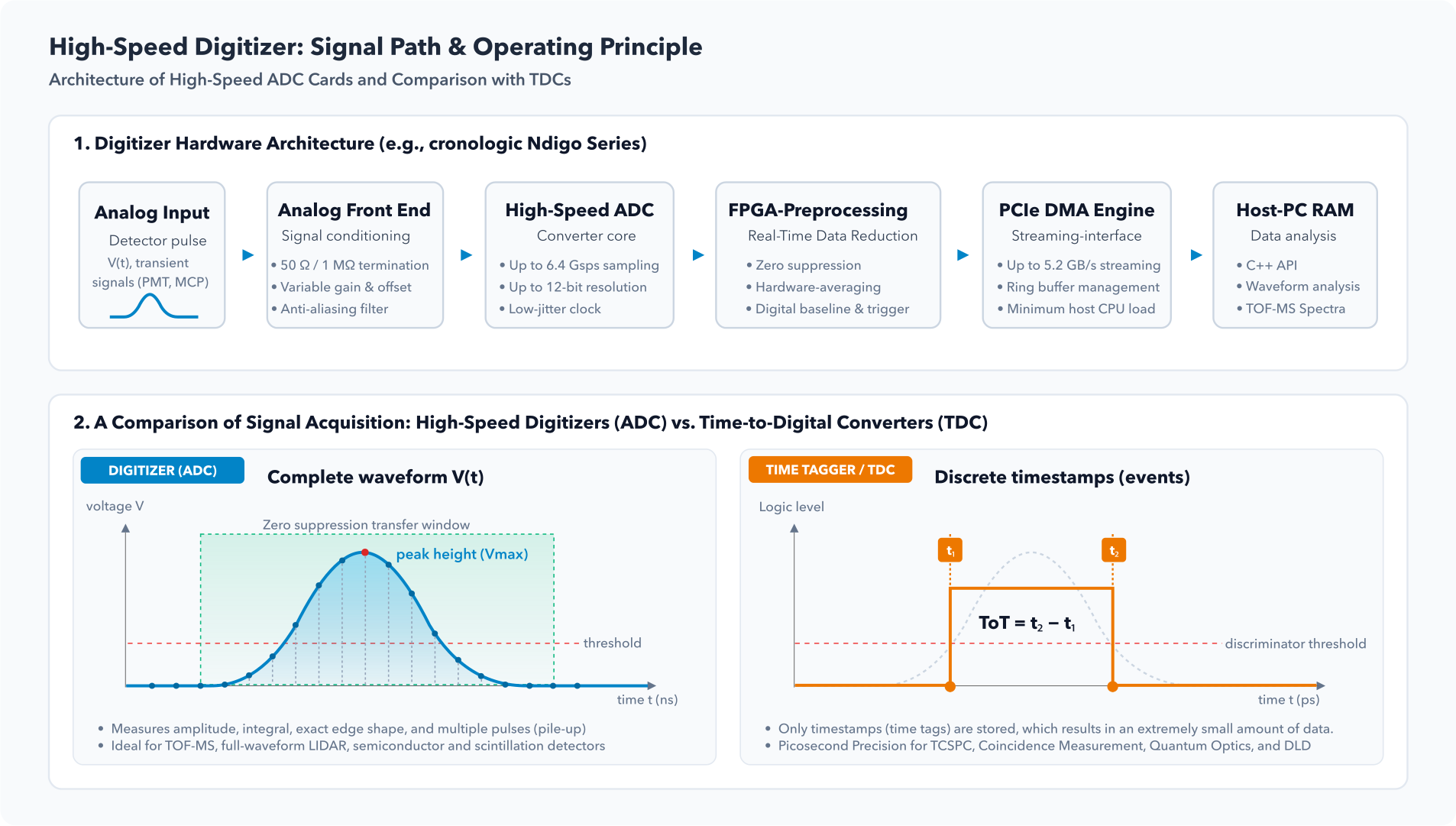
Architecture of a high-speed digitizer: The analog input is conditioned, sampled at several GS/s, and processed in real time by an onboard FPGA (e.g., zero suppression or hardware averaging). The processed waveform data is streamed directly to host memory via PCIe DMA without CPU overhead.