


buncher
Pre-Buncher, Phase Buncher, RF Buncher, Radiofrequency Buncher, Velocity Modulator
A buncher is a radio-frequency (RF) cavity or resonator that periodically modulates the velocity of charged particles travelling in an ion or particle beam. As faster particles catch up with slower ones during their subsequent drift, the continuous beam is compressed into short particle bunches.
Beam bunching is an essential technique in particle accelerators because many acceleration stages and experimental systems require particles to arrive in well-defined time intervals. Bunchers improve beam capture, increase interaction efficiency, and synchronize the particle beam with downstream RF structures or experimental equipment.
Because bunchers determine the temporal structure of the beam, precise timing electronics are frequently used to characterize bunch length, bunch spacing, and arrival-time distributions. High-resolution TDCs and fast ADC digitizers therefore play an important role in accelerator diagnostics and beam instrumentation.
Bunchers are widely used in TOF-SIMS (Time-of-Flight Secondary Ion Mass Spectrometry) systems, ion accelerators, linear accelerators (LINACs), mass spectrometry, accelerator physics, and other charged-particle beam applications.
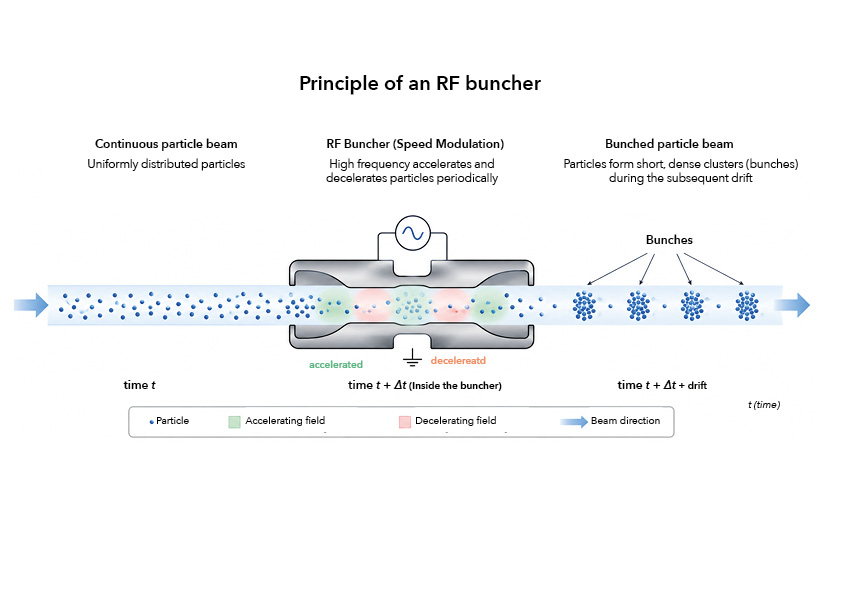
Operating principle of an RF buncher: Periodic velocity modulation causes faster particles to catch up with slower ones during their subsequent drift, compressing a continuous beam into short particle bunches. The resulting beam timing structure can be characterized with high-resolution TDCs and fast ADC digitizers.