


atomic interferometer
quantum interferometer, atomic wave interferometer, matter-wave interferometer
An atomic interferometer is a high-precision measuring instrument based on the principles of quantum mechanics. It utilizes the wave properties of atoms to enable extremely accurate measurements of various physical quantities such as acceleration, rotation, gravity, and time.
Due to their high precision and sensitivity, atomic interferometers are of great importance in a wide variety of scientific and technological fields. They are a prime example of the application of quantum mechanical principles in the real world.
The Role of TDCs and ADCs in Atomic Interferometry
To fully exploit the enormous accuracy of an atomic interferometer, high-precision control and readout electronics are indispensable. The manipulation and detection of atoms are based on extremely time- and signal-sensitive processes in which Time-to-Digital Converters (TDCs) and Analog-to-Digital Converters (ADCs) play a central role:
Time-to-Digital Converters (TDCs): The manipulation of atomic matter waves—i.e., splitting, redirecting, and recombining—is typically performed by precisely timed laser pulses that act as optical beam splitters and mirrors.
- Pulse Timing: TDCs are essential for the exact timing control and monitoring of these laser pulse sequences. Even the smallest timing deviations (jitter) would disrupt the phase of the atomic wave and falsify the measurement result.
- State Readout (Time-of-Flight / TCSPC): At the end of the interferometry process, the state of the atoms is often detected via fluorescence. TDCs are used here for precise time-of-flight measurements or for counting individual fluorescence photons (Time-Correlated Single Photon Counting, TCSPC).
Analog-to-Digital Converters (ADCs):
- Signal Acquisition: Capturing the interference pattern often produces complex, transient analog signals (e.g., from photodiodes measuring the fluorescence or absorption light of the atoms). Fast, high-resolution ADCs are required to digitize these weak and short-lived signals without artifacts. The exact shape and amplitude of the recorded peaks determine the final phase shift and thus the measured physical value.
- Active Stabilization: Modern atomic interferometers require constant monitoring and readjustment of their environment. High-speed ADCs are used to sample laser intensities, frequencies, and external disturbance factors like magnetic fields in real time, allowing control systems to immediately correct any drifts.
In summary, high-performance data acquisition systems with precise ADCs and TDCs form the electronic backbone of modern atomic interferometers, making their reliable application—for example, in quantum sensing or high-precision navigation—possible in the first place.
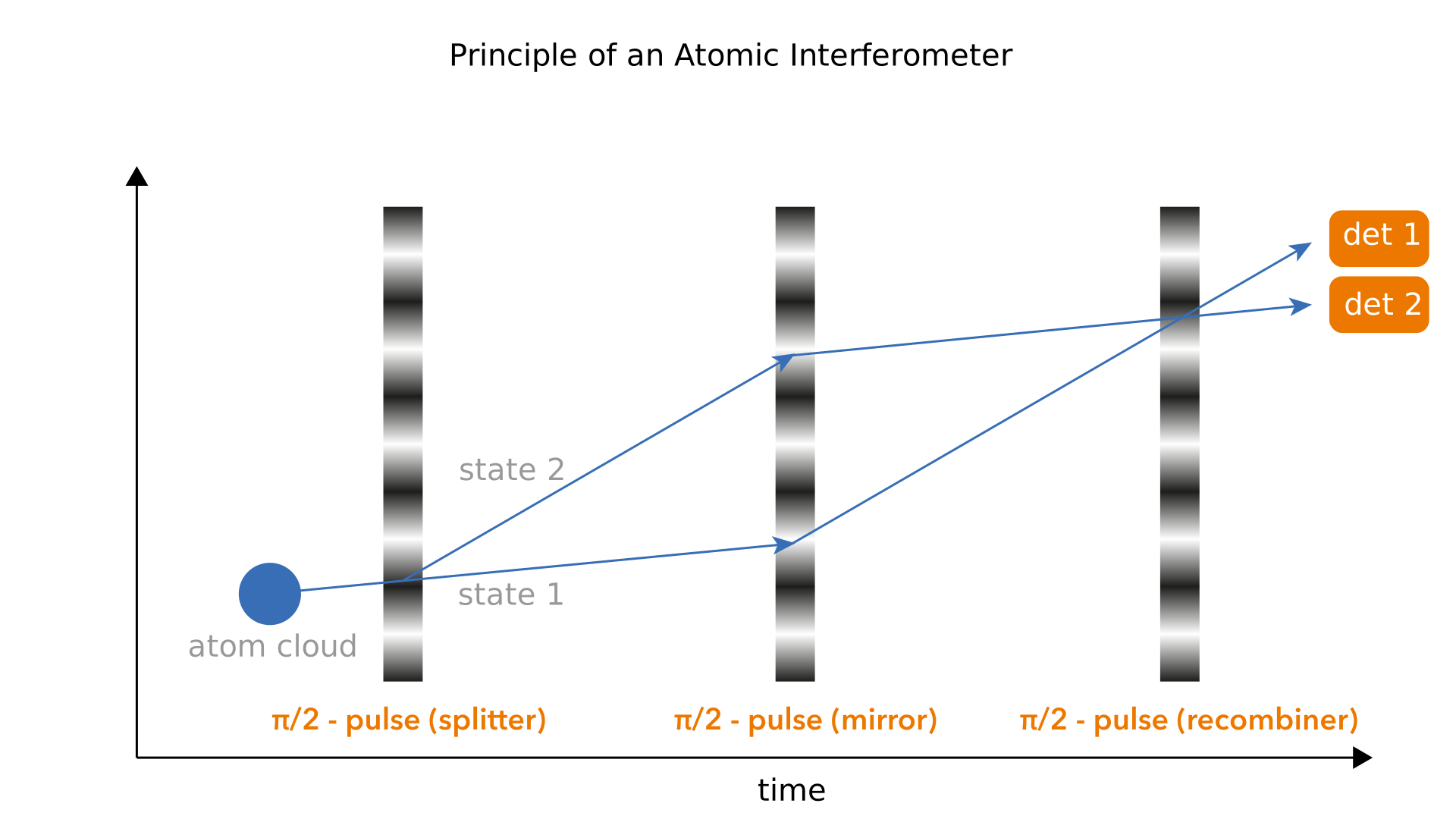
Schematic diagram of an atomic interferometer (Mach-Zehnder geometry): The matter wave of an atom cloud is manipulated by a precisely timed sequence of laser pulses. A first π/2 pulse acts as an optical beam splitter, separating the atoms into two quantum mechanical states (paths). A subsequent π pulse functions as a mirror, redirecting the paths towards each other. A final π/2 pulse recombines the matter waves, creating quantum interference. Depending on the phase shift the atoms accumulate along their distinct paths, the probability of them being recorded by Detector 1 or 2 changes. The highly precise acquisition of these output signals relies on advanced TDCs and ADCs.